INTRODUCTION
We should know the importance of art in Indian History. The artist must give pleasure to the spectator at the same time the art must have amusing and enjoyable.
However we cannot predicate the birth of the drawing art, we can assume that, according to Hindu purana, it was the birth of drowing, when Sathu Narayana sketch a feminine in his own lap and give birth to a beautiful woman named “Urvassi”.
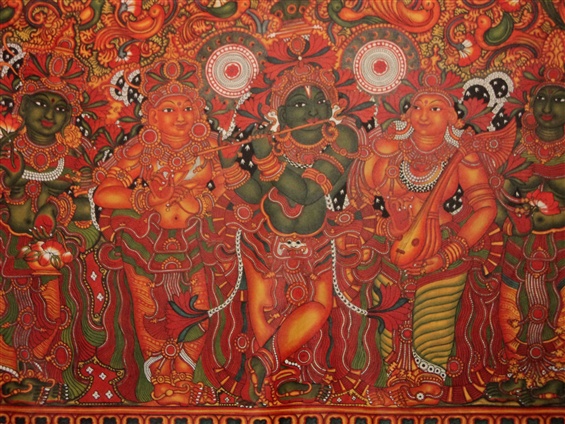
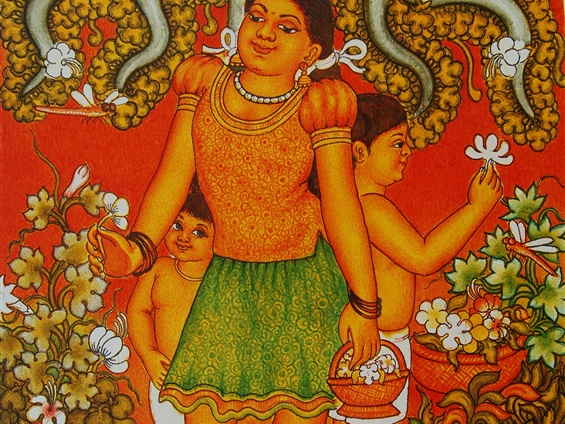
According to “Vishnu dharmothara purana” there have been 64 arts we should give a prominent place to art. traditional murals closely reflect the Dravidian and the Pallava style of art. Rather it can be said that mural painting of Kerala resembles the Kalamezhuthu Dravidian style. In the present age only sketchy outline of traditional murals exist in temples, the palaces and churches. But initially during the ninth and tenth century the murals had flourished hugely in the state of Kerala.
Archeologically evidences point to the fact that the must prolific period of Kerala murals were during the mid 6th and 7th century. It can be said that the mural paintings of Kerala were an intelligent combination of both aesthetic as well as technical features.
The subject matter of Indian murals was mostly religion various aspects of Hindu as well as Christian religion profusely decorated the temples, the palaces and the churches of India. The representation of Hindu god and goddesses did not just spring from imagination of the artist but on the other hand they were produced from the description which were found in the invocatory Dhyana slokas which were dedicated to the gods and goddesses.
Padmanabhapuram palace murals in Kerala reflect the native architecture as well as the artistic styles of the state. But even the native style of art are represent with the images of gods and goddesses from the Hindu pantheon.
Christian murals occupy an important place in the mural paintings of south India. A very common feature of church murals is paintings in art on the wooden altars. Murals also decorate the walls around the altar and also the roofs above the altars were not deprived from the glory of mural paintings. The theme of church murals in Kerala are generally from the Christian mythology as well as from the Holy Bible.
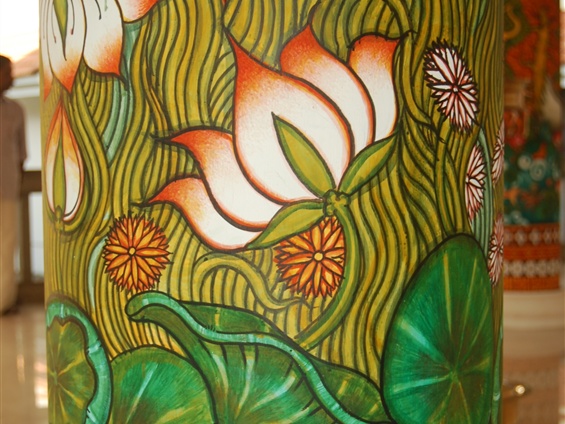
Painting a mural requires a great deal for preparation, equipment, and effort but few oil form can be presented on a similar scale. The mural artist used specially five colour (Panchavarna). The colours are while, yellow, red, green and black. The mural artist are basically used natural colours, but it is very difficult to make it. The artist can be used acrylic colours in canvas.
* Kaliya Mardhanam 
KALIYAMARDHANAM
In this canvas Kaliya Mardhanam (3 x 2 feet height and breadth) is applied to acrylic paint and fully presented by the dance of Lord Krishna on the head of poisoned naga is named Kaliya.
According to Hindhu mythology, the poisoned naga name is Kaliya living in Yamuna river in Brindhavan. The water of Yamuna boiled and bubbled with his poison. No bird and no beast could go near and one solitary Kadamba tree grew on the river.
Once Krishna and herd boys were playing balls and while playing the ball fell in to the river, Krishna, climbed up the kadamba tree and hung over the river bank. Krishna jumbed after it kaliya rose up with his hundred and ten hoods vomiting poison and wrapped himself around Krishna’s body. Krishna became so huge that kaliya had to released him. So Krishna save himself from every attack and danced on his head at last the naga’s wives came and prayed to Krishna pardon and worshipping Krishna.
Kaliya recognizing the greatness of Krishna and surrendered. So Krishna parodoned him and then let him go free to leave the river and go Ramanaka island.
Varnana
In this canvas, the lord Krishna is applied to blue colour and dress is red, green and yellow. In this painting Krishna is modified by gold ornaments and crown with ‘Mayilpeeli’. Kaliya has five head. Its body is dark blue colour. (blue colour expresses the poisoned figure). His wives have surrounding him with pardon and worshipping of Krishna.
______________________________________________________
* Rugmini Swayamvaram
RUGMINI SWAYAMVARAM
In this canvas Rugmini Swayamvaram (3 x 2 feet height and breadth applied to acrylic paint. In the painting fully presented by Lord Krishna marrying Rugmini in Mahabaratha.
The Vidharbha princess Rugmini is bethroated to marry a prince named Sisupala. But she did not want to marry him. She like Lord Krishna and decided to marry him. She secretly wrote a letter to Krishna. Krishna recognized the love of Rugmini. Krishna arrived in the kingdom Vidharbha where Rugmini was waiting for anxiously him. She had full faith that he will come, but her wedding to Sisupala had been set for that very day and for arrangements were being made for the ceremony. But Krishna catch Rugmaini from Sisupala in the battle Krishana chased the soldier of Sisupala. Krishna won and took Rugmini home with him to be his first wife.
In this canvas, applied to Krishna blue colour and Rugmini is yellow colour and beautiful ‘Varanamalyam’ has on her hands.
______________________________________________________
* Govardhanodharanam
GOVARDHANODHARANAM
In this canvas ‘Govardhanodharanam’ (3 x 2 feet height and breadth) applied to acrylic paint.
‘Govarthanodharanam’ is celebrated the day after Diwali it is the day Lord Krishna defeated Indra, the deity of thunder and rain. According to ancient vaishnava legend the vedic deva (demigor a king to guardian angel) Angel, Indra (the god of rain and lightining) was feared by human beings because he would either give the people no rain or flood them. If he was no satisfied with their worship When Krishna found out he opposed the performance of sacrificial worship of Indra. He emphasised the importance of Karma and doing once duty. This supposed by made Indra angry at the boy Krishna and flooded village. Krishna then lifted Govarthanam (a mountain) and held it up as protection to his people and cattle from the rain. Indra finally accepted of his defeat and recognized Krishna as supreme.
In this canvas, Lord Krishna is presented in blue colour, and he lifting the ‘Goverdhanam’ by small finger at left hand and flouting with right hand for yellow dressed Radha, all gopi and Gopans, birds and animals is presented around of Krishna.
______________________________________________________
* Banyan Leaf Krishna (Alilakannan)
SREE KRISHNA
In this canvas ‘Alilakannan’ 3 x 2 feet height and breadth is used by Acrylic paint. This picture presents during the universal deluge the supreme Lord Narayana takes the form of a little baby floating on a banyan leaf over the dangerous torrents of ‘Pralaya Jalam’ the water of cosmic dissolution.
During the universal deluge, he protects all the universe and its being by swallowing them in his tiny stomach and rest them there while contemplating about their creations once again after the deluge by releasing the universe and its being from the safe storage place.
“Leela sukha” (Bilva mangala Takur) in one of his Sree Krishna karnamritha slokas 2.57 describes the baby (Balamukundha) that floats on the pralaya waters on top of a banyan leaf after swallowing universe and its contents for their protection.
Slokas – Kararavindhena padharavindham
Mukhara vindhe vinivesayantham
Vadasya pathrasya pudesayanam
Bala Mukundham Manasasmarami
In this picture fully presented the beautiful face of Lord Krishna is like ‘Aravindham’ (Lotus flower). The flood water is in blue and baby Krishna is in blue colour and banyan leaf is green colour.
______________________________________________________
* Navaneethachoran
NAVANEETHACHORAN
In this canvas ‘butter thief Krishna’ is (3 x 2 feet height and breadth) applied to acrylic paint. It is presented the Lord Krishna brother Balarama steals butter from Gopikas houses. In this story of ‘Krishna Leela’, we enjoyed the childish activities of Krishna and Balarama.
Yasodha, Rohini and Gopikas were enjoyed the naughty childish activities of Krishna and Balarama in herd house. All the Gopikas assembled and went to mother Yasodha to complaint against the restless boys when Krishna was sitting before mother Yashodha all the elder Gopis began to lodge complaint against him.
In this canvas gives Lord Krishna is green and Balarama is yellow colour. They steals butter from a pot, Krishna stands on a stool and takes butter from the pot near Balarama stands eating butter.
______________________________________________________
* Rasaleela

RAASALEELA
In this canvas ‘Rasaleela’ is applied to acrylic colours in 3 x 2 square feet canvas. According to Hindu purana, the word ‘Rasaleela’ refers the connection of Jeevatma to paramatma. Rasaleela take place at one night in ‘Vrindavanam’. Krishna dances with Radha and her sakhies. In this canvas pictured the Lord Krishna and Radha Rani at the time of ‘Rasaleela’.
Lord Krishna is one of the favourite deities of Hindus. He is worshipped for his immense power, captivating appearance, unique charm and playfulness. For some, he is the hero, a lover or the guide, while for other he is a child. He resides in the heart of every devotee and fulfils everyone’s wish.
In this canvas refers Radha who dances with Krishna at Rasaleela time. The concept at ‘Rasaleela is the relationship with Radha to Krishna or Gopi to Krishna. Radha is regarded as an incarnation of Goddess Lakshmi. Radha and Krishna is the eternal love and belief. Radha is Krishna’s friend and advisor. She is considered as his original shakthi and other Gopis are considered her maid servants.
In this canvas Krishna dances with Radha at the time of Rasaleela. The body of Krishna is blue colour and the dresses are red, green and yellow colour. The body of Radhais yellow colour and the dresses are red, yellow and green colour. White colour lotus are in their hands. Background designs are leaves and flowers.
______________________________________________________
* Radhamadhavam 
RADHAMADHAVAM
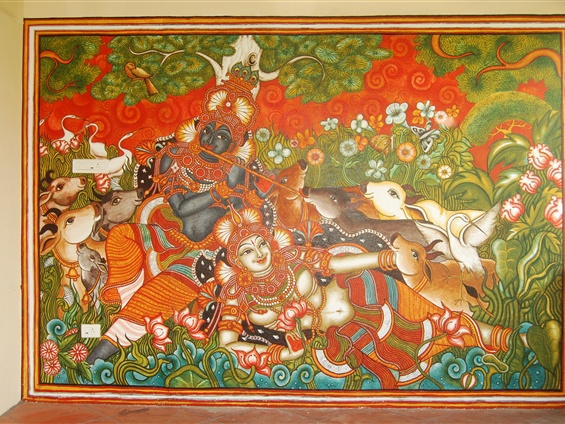
In this canvas ‘Rahamadhavam’ is applied to acrylic colours in 3 x 2 square feet canvas. In this canvas pictured the Lord Krishna, Flutist, plays flute and sits under a tree and Radha who is the incarnation of Goddess Lakshmi sleeps on the lap of Lord Krishna. It is a beautiful concept of the relationship between Krishna and Radha in Hindu purana.
The love of Radha and Krishna needs no introduction. It is an never ending attraction, emotion, passion, adoration and devotion deeply rooted in our minds down through the ages. ‘Radhamadhavam’ considers, it may be the infatuation of young couples or as the craving for of the fulfilment of the innate urges for procreation in man and woman or it can be pictured at the restless fluttering of the Jeevathma to merge is the Paramathma.
Traditions worshipping Krishna as ‘Swayam Bhagvan’ who is a male include reference and veneration to his Radha. Who is worshipped as supreme. It is an accepted view that union of Radha and Krishna may indicate the union of sakthi with the sakthiman.
According to Rig veda,
“Among all persons, it is Sri. Radha in whose company Lord Madhva is especially glorious”
From the Vaishnava point of view the divine feminine energy implies a divine source of energy. Radha has her Krishna as Krishna is believed to be the source of all manifestations of god. In this canvas, Krishna sits on the bank of Yamuna and Radha has to lay near Krishna and enjoys the flute of Krishana. The body of Krishna is painted blue colour and his dresses are painted yellow, green and red colour. The body of Radha is painted yellow colour and the dresses are also painted yellow green and red colour.
______________________________________________________
* Malliyoor Ganapathy And Krishna
MALLIYOOR GANAPATHI AND SREE KRISHNA
In this canvas ‘Malliyoor Ganapathy’ is applied to acrylic colours in 3 x 2 square feet canvas. According to Hindu mythology, the Lord Ganapathy consists he can remove all our obstacles. In Malliyoor, the Lord Ganapathy is in Vaishnava concept and a baby Krishna was seated on his lap to worship the Bhaktas.
The Malliyoor Sree Mahaganapathy temple in Kottayam district, Kerala is the sacred abode of the all encompassing divine presence of Lord Ganesha and also a coveted destination of Lakhs of pilgrims from all over India. The endearing elephant headed Ganesha the son of Siva and Parvathy enjoys prime place among all the Gods in the Hindu pantheon. He is parabramha, incarnate the God of wisdom and learning, the remover of all obstacles and worshipped first any other god. The Malliyoor Sri. Mahaganapathy temple is incomparable in the concept of the presiding deity as Vaishnava Ganapathy with a young Sree Krishna seated on the lap of the Lord Ganesha.
In this canvas Lord Ganapathy was sit on a pedestal and a boy Krishna was sit on the lap of Ganapathy. The body of Ganapathy is yellow colour and his dresses are green, yellow and red. The body of Krishna is blue colour and his dresses are yellow, green and red. A laddu has Krishna`s right hand and a flute has left hand. The background of canvas are flowers and leaves.
History
The story goes that a deeply devotee and saintly Brahmin brought the idol over here from an unidentified and unspecified pilgrim centre some where in the north centuries back. The family deities Anthimahakalan and Yakshi worshipped by the once powerful administrators of the temple also find a place inside the temple complex. The temple is jointly administrated by two families the Aryampallymana and Vadakkedath mana. In course of time the two families were went through a period of misfortune and penury the malliyoor family bearing a brunt of it. But they worshipped Lord Ganapathy with unwearin devotion even when the temple was out a root over the sanctum sanctarum.
Once again a small house came for the priest on a piece of plot donated by Brahmasree Kaithamattom Namboothiri. Finally the priestly family managed to have a hand to mouth existence but the temple continued to be in its dilapidated state.
______________________________________________________
* Venugopalam
VENUGOPALAM
In this canvas ‘Venugopalam’ is applied to acrylic colours in 3 x 2 feet canvas. In this canvas sketched Krishna who is the greatest flutist, plays flute.
Flute is the oldest musical instrument known to mankind. Every one is attracted towards the melodious sound of flute which is Lord Krishna’s favourite instrument. Bamboo flute is the only musical instrument which is the most natural and does not contain any mechanical part. This is the reason the flute is very close to nature and sounds very melodious when played in an atmosphere surrounded by nature.
Flute along with mouth organ is one of the very few instruments which are portable. Flute sounds best when played in the atmosphere surrounded by nature. For example, if you take a short flute to mountains or a thick forest and then play the echo of the sound bouncing back either from the leaves of the trees or from the mountains is simply very delightful. Every flute player in such circumstances receives a celestial experiences. Nature, actually talk back to you. In this canvas Krishna sit in ‘Brindavanam’ and play flute in right hand. A cow stands behind him and looks him. A peacock stands left side of him. The river Yamuna has painted in blue colour. The body of Krishna is painted green colour and the dree is painted in blue, yellow and red colour.
______________________________________________________
* Chathurbhahu Krishna (Guruvayoorappan)
* CHATHUR BHAHU KRISHNA(GURUVAYOORAPPAN).
CHATHUR BHAHU KRISHNA(GURUVAYOORAPPAN)
In this canvas ‘Guruvayoorappan’ is applied to acrylic colours in 3 x 2 square feet canvas. This canvas sketched Lord Krishna named ‘Guruvayoorappan’ who is the form of Vishnubhagavan.
‘Guruvayoorappan’ is the form of Vishnubhagavan worshipped and held is irreverence by Hindus predominantly in south India. This is located in the town of Guruvayoor in Kerala in India. The word Guruvayoorappan means the Lord of Guruvayoor comes from the word Guru referring to Brihaspathi the Guru of Devas ‘Vayu’ the god of wind ‘appan’ means the father or Lord in Malayalam since Guru and Vayu installed the idol of Krishna the name “Guruvayoorappan” was given to the deity.
It is believed that the idol of Guruvayoorappan was worshipped by Vasudeva, the father of Krishna and represents the full manifestation of Vishnu. The idol of Guruvayoorappan is made of a stone called ‘patalaanjanam’ or stone of collyrium and is in the standing pose with four arms carrying panchachannya (shanku or conch) the sudarsana chakra (chakra or disc) the Kaumodaki (gada or mace) and padma (lotus). The idol face east and is almost 4½ feet tall. Guruvayoor is also hailed as ‘Bhuloka Srivaikundam’ meaning ‘heaven in earth’ where the deity reveals himself to his devotee in the same majestic form in which he welcomes them in Vaikunda his celestial abode.
In this canvas four hands Krishna named ‘Guruvayoorappan’ stands on a pedestal white colour flowers and leaves are in background. The colour of Krishna is blue and dresses are yellow, green and red colour. Sudarsana chakra (a disc) has his right upper hand, panchja (a conch) has his left upper hand, sree padmam (a lotus) has right hand and Kaumodaki (a mace) has his left hand. Kriushna weares Kaustubhamala (a diamond necklace) and Makarakundala (a carring). He also wears a beautiful crown with the plume of peacock. A halo was set behind him. The colour of Krishna ‘blue’ refers ‘arjuna varnam’ )the colour of black bismuth)
______________________________________________________
* Dangling Krishna and Radha
*
DANGLING KRISHNA
DANGLING KRISHNA
In this canvas ‘Dangling Krishna and Radha’ is applied to acrylic colours in 3 x 2 square feet canvas. According to Hindu purana, Krishna is the supreme of god and Radha is the incarnation of goddess Lakshmi. Radha and Krishna were made for each other. They are the symbol of passion and love.
The love of Radha and Krishna needs no introduction. It is an never ending attraction, emotion, passion and adoration. This picture considers the infactuation of young couples or as the craving for of the full filment of the innate urges for procreation in man and woman or it can be pictured at restless fluttering of the Jevatma to merge is the Paramathma.
In this canvas Krishna and Radha were sit on a dangle. A yellow colour flowers has Krishna`s left hand white colour Lotus has Radha`s right hand. The body of Krishna is green colour and dresses are yellow, red and blue colour. The body of Radha is yellow colour and dresses are red, yellow and green colour. The background of the picture are tree, leaves and flowers.
______________________________________________________
* Krishna with Cow

COW BOY KRISHNA
In this canvas ‘Cow boy Krishna’ is applied to acrylic colours in 3 x 2 square feet canvas. In this canvas sketched the boy Krishna drinks the milk or Amrit of Gomata.
According to Hindu mythology ‘cow’ is the concepts of Gomata. Yadava consider that cow is the Gomata and the wealth of a person measured by how many cows he had. According to Vastu sastra, all vastu dosh is corrected in a house where cow is living. Cow is considered to be the mother, most loving entity.
Krishna lives in Gokula Vrindavana. It is simply a huge pasturing ground for Krishna’s cows. According to Hindu mythology serving a cow means serving all gods. ‘Gavu’ means cow and ‘shala’ means ‘shed’. According to Hindu mythology all the devi devatas (gods) resides in the body of cow. The holy cow ‘Kamadhenu’ emerged out while ‘churning of cosmic ocean’.
In this canvas Krishna drinks milk of Gomata. The background of the pictures are a river, flowers and leaves. The colour of river is blue. The body of Krishna is blue and Gomata is white.
By
Mural Painting Artist
Sastrasarman Prasad T. S.